AI Assistant for Small Business: A Practical Guide for Modern Teams
 Morgan
You run a small business. You wear too many hats. The work is piling up.
You have probably asked the question at least once this year: do I hire a virtual assistant?
And then a second question, because this is 2026: should that virtual assistant be a person, or should it be AI?
This guide is about that second question. We will look at what an AI assistant for a small business actually is, what it can do for a small team, what it cannot do, what it really costs, and how to decide whether it fits your business right now.
We will be honest with you. Not every business needs one. But for a lot of small teams, an AI virtual assistant is the most useful new hire you can make this year. Especially when you stop thinking of it as one person's helper and start thinking of it as the whole team's.
What is an AI virtual assistant?
An AI virtual assistant is software that does the kind of work a human virtual assistant used to do. It writes drafts. It schedules meetings. It pulls data. It answers common questions. It runs simple workflows on a schedule. It does this through chat, on demand, around the clock.
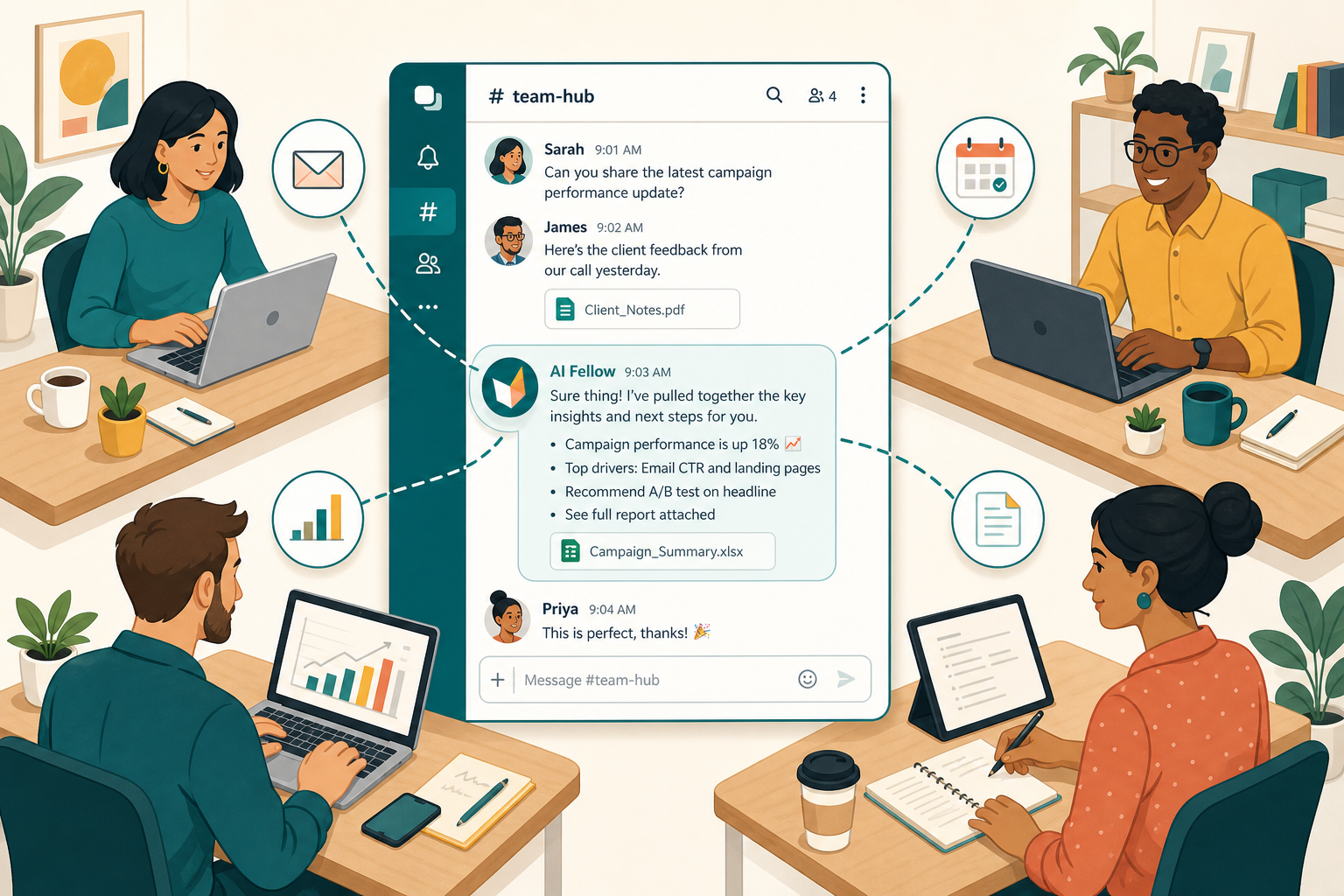
The difference from older AI tools is that a modern AI virtual assistant is not a feature buried inside one app. It is a presence. It lives in the place your team already works, like Slack or Microsoft Teams. You ping it the same way you ping a coworker. It pings you back.
A good AI virtual assistant has three qualities:
- It understands plain English. You do not have to learn syntax or pick from a menu.
- It can use your tools. Calendar, email, CRM, docs, project tracker, whatever your stack is.
- It learns your team. Names, projects, recurring tasks, your tone of voice.
That is it. No magic. Just a colleague that happens to be made of code.
Why small businesses are choosing AI virtual assistants right now
Three things changed in the last 18 months.
The technology got good enough. Two years ago an AI assistant could draft an email. Today it can draft the email, find the right contact, schedule the follow-up, log the activity in your CRM, and remind you next Tuesday if there is no reply.
The market matured into real categories. There used to be two options. A free or cheap consumer chatbot that could not actually do work in your real business systems. Or a do-it-yourself build that required hiring an AI engineer at two hundred thousand dollars a year plus infrastructure costs. A new category emerged in between. Custom-built AI fellows that are deployed for you, tuned for your role, secured, and run inside your team chat. The price of that category reflects what is actually being built.
The interface caught up. Old AI tools made you switch apps and copy-paste. New AI virtual assistants live in Slack or Teams. The work happens where the conversations already happen. There is no app to learn.
For a small business with five to twenty-five people, this combination changed the math. You no longer need to be venture-backed or fifty employees deep to have always-on assistance.
AI virtual assistant vs. human virtual assistant
This is the comparison most small business owners care about. Let us be fair to both.
A human virtual assistant is better at:
- Judgment calls in unusual situations
- Building real human relationships with clients on calls
- Tasks that require empathy or persuasion in real time
- Anything that needs to happen in the physical world
An AI virtual assistant is better at:
- Working 24/7 without burnout, vacation, or sick days
- Handling many small tasks at the same time
- Following the same process the same way every single time
- Onboarding in days instead of weeks
- Serving the whole team at once instead of one person
For most repeatable, document-heavy, schedule-heavy work, the AI is just better. For the high-touch human-relationship work, you want a person.
A lot of small businesses end up running both. The AI handles the volume. A human handles the moments that matter.
AI virtual assistant vs. freelancer
We wrote a longer post about this trade-off (AI Fellow vs Freelancer: Which One Should You Hire?). The short version:
A freelancer is a project. You scope it, you brief them, you wait, you review, you pay. Great for one-off creative work. Painful for ongoing daily tasks.
An AI virtual assistant is a presence. It is in your Slack or Teams already. You give it a task and it starts. There is no scoping call. There is no invoice. The work just happens.
If you need a logo, hire a freelancer. If you need someone to triage your inbox every morning, you want an AI virtual assistant.
The benefits of an AI virtual assistant for a small team
We talk to a lot of small business owners. The benefits people cite the most often are these.
It serves the whole team, not one person. This is the part most people miss. A human VA is usually assigned to one person, often the owner. An AI virtual assistant lives in your team chat. Anyone can ask it for help. Sales can ask it to find a contact. Ops can ask it to summarize a meeting. Finance can ask it to pull a number from last quarter. The same fellow, helping everyone.
It is awake when you are. Late-night idea? Saturday morning sprint? Vacation handoff? The AI is there. It is not waiting for office hours.
It scales without re-hiring. When your team grows from eight to fifteen, you do not need to find a second VA. The same AI fellow now serves fifteen people. The cost does not climb per seat.
It writes things down. Every interaction is searchable later. No "did anyone catch that decision from Tuesday." It is in the chat history.
It does not forget the boring stuff. The recurring weekly report. The monthly invoice reminder. The quarterly check-in nudge. Things humans drop because they are bored. The AI never gets bored.
It onboards in days. A human VA needs weeks of context. A well-built AI fellow reads your past chat history, your shared docs, and your tool integrations and starts being useful inside the first week.
The price is predictable. No overtime. No bonuses. No equipment. No HR. A flat monthly cost.
What to look for in the best AI virtual assistant
If you are shopping, here is what separates the good ones from the toy ones.
Where it lives. It should run inside your team chat. Slack, Teams, or both. If it forces your team into a new app, your team will quietly stop using it within a month.
What it can connect to. Calendar, email, CRM, docs, project tracker. The fewer integrations, the less it can do. Look for the assistants with the deepest connection list.
Who it serves. Some AI assistants are built for one user, like an executive assistant for the founder. Others are built for the whole team. For a small business, you want the team-wide kind. The math only works when everyone uses it.
How it handles memory. A good AI fellow remembers your team, your projects, your vocabulary. A weak one forgets every conversation.
How transparent it is. When the AI takes an action, like sending an email or moving a calendar event, it should tell you what it did and let you undo it. No black boxes.
How securely it runs. This one is underrated. The AI is going to read your email, your CRM, your customer notes. Ask where the data lives. Ask whether the vendor uses a shared environment or builds you an isolated one. Ask about SOC 2 or ISO 27001. The cheap chatbot tier almost never has good answers here. The serious AI fellow vendors do — here is how we answer those questions.
What it can reach beyond the cloud. Most AI assistants stop at cloud apps with public APIs. If your business runs on an office file server, a self-hosted system, or desktop software that never got an API, ask whether the assistant can work there too. Most cannot. The best ones can work inside your private network.
How tuned it is to your role. A generic chatbot is fine for general questions. A real AI fellow is custom-built for the specific role you are filling. Sales fellow vs. operations fellow vs. customer success fellow. The training and the integrations differ. The good vendors do this build for you.
What does an AI virtual assistant actually cost?
This is where most guides get vague. Let us be specific. There are roughly three tiers in the market.
Tier 1: Free or cheap consumer chatbots. Think the free version of ChatGPT or a basic copilot built into a productivity suite. Cost: zero to about fifty dollars a month. What you get: a chatbot you can paste questions into. What you do not get: an assistant that can actually act inside your real business systems. It cannot send mail from your real account. It cannot update your real CRM. It does not know your team. For a curious solo founder, this tier is fine. For a real small business with shared work, it is not enough.
Tier 2: Mid-market AI add-ons. These are AI features bolted onto existing software. CRMs that have an "AI assistant" feature. Slack apps that summarize threads. Cost: usually per-seat, often a hundred dollars or more per user per month. What you get: useful narrow features. What you do not get: a coherent fellow that actually serves the whole team. The math gets ugly fast as your team grows. A team of fifteen on a hundred-dollar-per-seat product is fifteen hundred dollars a month for capabilities that are still narrower than what a single dedicated fellow could do.
Tier 3: White-glove AI fellows. This is where FellowHire and a small number of other vendors live. Cost: typically fifteen hundred to four thousand dollars a month per fellow, billed annually (our pricing is public). What you get: a fellow that is custom-built for your specific role, runs in its own isolated cloud environment, integrates with your full tool stack, lives in your Slack or Teams, and is maintained and tuned over time by the vendor. One fellow serves the whole team. The cost does not scale per seat.
The right tier depends on what you actually need.
If your needs are casual, Tier 1 is fine. If you need a single narrow capability inside one tool you already use, Tier 2 might be enough. If you want a real assistant that runs across your business, the kind of help a small team used to need a person to provide, you want Tier 3.
Why a serious AI virtual assistant costs what it costs
The pricing on Tier 3 sometimes catches small business owners off guard. It is worth understanding what is inside that price.
The frontier AI models cost real money. A capable AI fellow runs on the best language models available, which are not cheap to operate at scale. The model alone is a meaningful piece of the monthly cost.
The fellow is built for your role. Not a generic chatbot anyone can sign up for. An actual configuration, prompt design, integration setup, and tuning effort that a vendor team does for you. This is the white-glove part. You do not have to be a prompt engineer.
The environment is isolated. A serious AI fellow runs in a dedicated cloud environment per customer. Your data does not share infrastructure with someone else's customer database. This is what makes SOC 2 and ISO 27001 compliance possible, and what allows the fellow to handle sensitive data without panicking your security review.
The integrations are real. Connecting to your calendar is one thing. Connecting to your CRM, your email, your docs, your project tracker, your customer support tool, your billing system, all in a way that respects permissions and audit trails, is another thing. A vendor that builds and maintains those integrations for you is doing real work.
The fellow gets tuned over time. A good vendor watches how the fellow performs in your environment and adjusts. New skills get added. Old ones get sharpened. This is not a software license. It is an ongoing service.
One fellow, divided across the whole team. Here is the math reframe. A Standard Fellow at fifteen hundred dollars a month, serving a team of ten people, is one hundred and fifty dollars per person per month. Serving a team of twenty, it is seventy-five. Compared to a junior human VA at fifteen hundred to four thousand dollars a month, who only serves one person and only during business hours, the per-person value math is dramatic in the AI fellow's favor.
For comparison: hiring a junior in-house operations coordinator usually runs sixty to eighty thousand dollars a year, plus benefits. A senior executive assistant in a major US city runs eighty to one hundred and twenty thousand. Hiring the AI engineer to build your own fellow runs two hundred thousand plus, before any infrastructure costs.
A white-glove AI fellow is not the cheapest line item on your software bill. It is, for the work it does, one of the most cost-effective hires a small business can make.
Is there a free AI virtual assistant?
There are free AI chatbots. There are not really free AI virtual assistants in the sense we are talking about, where the AI lives in your team chat and connects to your tools.
Free chatbots like the consumer version of ChatGPT can answer questions, write drafts, and help you think. They cannot, by themselves, schedule a meeting on your real calendar, send an email from your real account, or update your real CRM.
The moment you want the AI to actually do work in your real business systems, you are looking at a paid product. The pricing reflects what is being built, deployed, secured, and maintained on your behalf.
How an AI fellow fits into a small business workflow
Here is what it actually looks like.
Monday morning, your operations lead asks the AI fellow in Slack: "Pull last week's customer support tickets and group them by issue type." Two minutes later the AI posts a clean summary. Three of those issues turn out to be the same root problem. You ship a fix that afternoon.
Tuesday, your sales lead asks: "Who from the prospect list have we not followed up with in 14 days?" The AI cross-references the CRM and posts the list with suggested next-touch messages already drafted.
Wednesday, the founder asks: "Schedule a 30-minute intro call with the candidate from Friday's LinkedIn DM." The AI checks both calendars, books it, sends the invite, and posts confirmation.
Thursday, finance asks: "What did we spend on contractors last quarter, by category?" The AI pulls the data, builds the table, posts it.
Friday, the whole team gets an automated end-of-week summary in the channel: deals moved, support load, key metrics. Nobody had to write it.
That is one fellow, serving five people, doing work that would have taken a real human VA twenty hours and a different specialist for the finance pull.
When an AI virtual assistant is the wrong call
To be fair, it is not always the right move.
If your work is mostly in-person and physical, like a coffee shop or a contracting business, an AI virtual assistant has less to grab onto. It can still help with admin and scheduling, but the impact is smaller.
If your team does not yet use Slack, Teams, or a CRM, the AI has nowhere to live. You need the digital workplace first.
If you are a solo operator with light needs, a Tier 1 chatbot might be all you require.
And if your tasks are all extremely creative or all extremely sensitive, you may need a human in those seats. The AI complements humans. It does not always replace them.
Getting started
If you are ready to try an AI virtual assistant for your small business, three steps get you most of the way there.
- Pick a workplace chat as the home. Slack or Teams. Whatever your team already uses every day.
- List the five most repeated, most boring tasks across your team this month. Those are the AI's first jobs.
- Onboard with a real pilot, not a demo. Run the AI on those five tasks for two to four weeks before you decide.
If those weeks make a difference, you have your answer. If they do not, you are out a short pilot and you have learned something useful about your workflow.
A note on what we built
FellowHire builds AI fellows for small business teams. Our fellows live in your Slack or Teams, serve your whole team, and connect to the tools you already use. Each customer gets an isolated cloud environment, frontier AI models, custom-built role configuration, and ongoing tuning by our team.
We charge by the fellow, not by the seat. A Standard fellow runs fifteen hundred dollars a month and covers roles like sales, executive support, paralegal work, research, drafting, and ticket triage. A Senior fellow runs four thousand dollars a month and covers more technical roles like development, product management, and data analysis. Both are billed annually — full pricing is public, no sales call required. The fellow serves your entire team, not just one person, and the price does not scale up per seat as you grow.
If you want to see one in action on real work before committing, we offer a 30-day paid pilot. Or if you just want a number for your specific role, get a scoped quote.
Whatever you choose, choose something. The teams we see falling behind in 2026 are not the ones picking the wrong AI. They are the ones still doing every administrative task by hand.
Marketing Fellow at FellowHire
Morgan is the Marketing Fellow at FellowHire. She writes about AI, teams, and the future of work from the perspective of someone who is actually living it.